
Designed for Two: The Co-op Philosophy of Josef Fares
Updated: Aug 20
We took a bit of extra time, but we're back with a new article on Josef Fares and his studio, Hazelight, which brought back co-op in an era when everybody was starting to forget about it. Sticking to a vision, even if everyone else in the market is not following, is what we love about his story and why more people should look at him as a great source of inspiration

The gaming industry often feels like it’s moving in circles. As a recent GamesRadar piece argued, citing Fumito Ueda’s belief that the “era of game mechanics” may be over, most modern titles are built on borrowed ideas, polishing familiar systems instead of creating new ones. It’s an understandable view: after decades of iteration, few genres remain unexplored, and the economic pressure to play it safe has never been higher.
But maybe innovation in games does not necessarily mean inventing a brand-new mechanic. Maybe it means committing fully to a clear vision, and executing it with consistency and courage. We think it’s very hard to say if Ueda is right or wrong on this, but there are examples in the market that show how there is still space to innovate, take risks, and be rewarded. Some ideas might not be what we would define as outright “innovations,” but they still bring something new to players and to the market overall. One of these examples is Josef Fares and his company, Hazelight Studios.
Since the early days, Fares has never really won with novelty technologies or massive scale. Instead, he focused on something much simpler and, at the time, almost forgotten: how players share experiences through games. He doubled down on co-op experiences exactly when much of the industry was moving away from them.
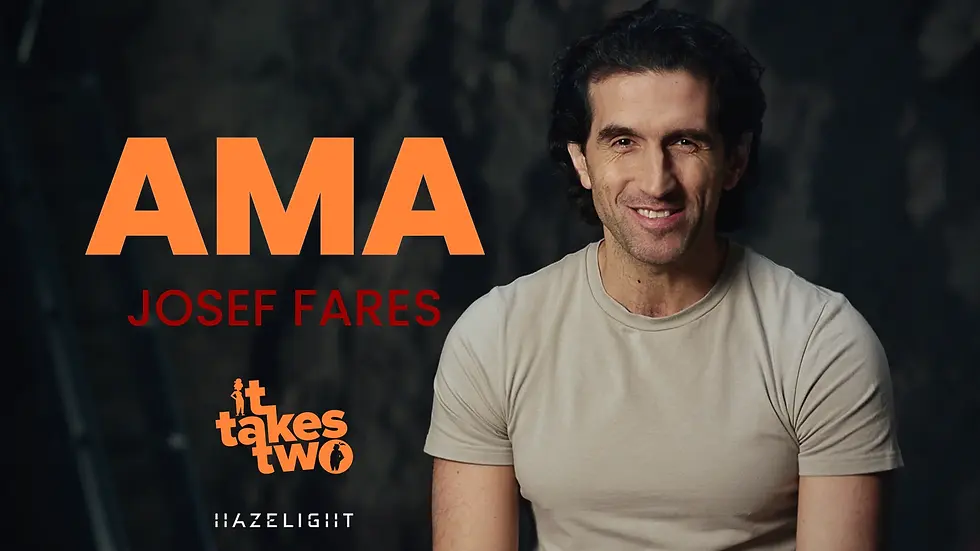
We thought it would be interesting to look at Fares’ career from the very beginning and see how he shaped his vision and how he became, from an outsider, one of the strongest voices in the gaming industry.
The first part of the article focuses on Fares’ career and on how the industry has evolved in regard to co-op experiences over the last 25 years; in the second section, we look more closely at what makes Hazelight unique as a studio, by looking at the game design of its latest three games.
If you want to jump to a specific chapter, you can use the links below.
Josef Fares - Short overview of his career
Today everyone knows Josef Fares. After getting into the spotlight with It Takes Two and winning Game of the Year at The Game Awards in 2021, his studio, Hazelight, recently released Split Fiction, once again one of the highest-rated games on Metacritic in 2025 (91 score).

What not many people probably know is that Fares has a very unique background, coming into gaming only recently after a promising career in the movie industry. He released five movies between 2000 and 2010 and was also included in Variety’s “upcoming directors to watch” list in 2006. Apparently, in between one movie and another, he was invited by a gaming school in Orebro, Sweden, for a lecture, which was then expanded into a prototyping workshop. We don’t have the details, but apparently this is when and how Fares started to work on his initial gaming idea, which led to his first game, Brothers: A Tale of Two Sons.
Why co-op games
What’s beautiful and interesting about Fares’ story is that, in a market that is more and more focused on making safe investments, his whole gaming career stemmed from going against the common sense of the industry. His first game, Brothers, was born from a single concept that 99% of the industry did not believe made sense at the time. The whole game revolves around this idea: “My hope is that your left hand is the young brother and your right hand is the big brother.” Who would invest in a pitch like this today?
Interestingly enough, Brothers is Fares' only single-player game. It is a bit unclear what made Fares change his approach with his following games, but an AMA on Reddit gives an idea of his thought process.
Q: Brothers: A Tale Of Two Sons [...] was more of a "single player co-operative" style (game). And now A Way Out requires at least two players, local or online, to play. Josef, what made you focus so much on the idea of co-operative play [...] ?
Fares: I just felt that there's an opportunity to tell good stories in co-op as well. I wanted to play a co-op game that isn't just drop-in drop-out, I wanted two different characters. We experience movies together, why not a story experience in a co-op game.
Before jumping into the analysis of Fares’ three main games, we wanted to briefly cover how the co-op market has evolved in recent years and at which point Hazelight came into it.
How the co-op games market has changed throughout the years
Anyone who grew up in the 90s surely remembers that local co-op was basically how games were enjoyed with friends. With consoles like the SNES, PlayStation 1, and Nintendo 64, many titles included two-, three-, or four-player modes on the same screen or with split-screen. Local co-op felt natural: one console, one TV, friends, siblings, family in the same room.
But the early 2000s changed the rules of the game. As consoles moved to HD and online services matured (such as Xbox Live and PlayStation Network), online play became smoother and more accessible. Party systems, seamless matchmaking, and the rise of competitive online ecosystems, driven by FPS franchises like Halo and Call of Duty, shifted the focus toward remote multiplayer experiences. The business case for online multiplayer became stronger. There’s some decent research about this topic on the Internet, such as this article, which suggests that the percentage of games supporting local co-op dropped significantly from averages around ~39% (2008–2013) down to ~10–21% after 2014.
At a point in time when the Internet was getting more and more attention from the industry, local co-op felt like an extra burden, requiring additional development work (multiple viewports, audio and design adapted for shared space), while also not being advantageous from a monetization standpoint, since a single sale would serve multiple people. This is when many big franchises either removed split-screen or omitted local co-op entirely.
From the mid-2010s, however, local co-op started to see a resurgence. Indie titles like Overcooked deliberately embraced co-op (sometimes highlighting it as a main selling point) and delivered strong critical and commercial success.
Fares doubled down on this concept, and with A Way Out (2018) he made two-player local and online co-op the only way to play. No single-player option. No 2+ players option. This was a bold signal: the co-op experience itself is the core.
Importantly, Hazelight did not simply revive couch co-op nostalgia — they blended local and online co-op seamlessly. In a world where players are often not in the same room anymore, that balance mattered.
The Hazelight Approach

So what made Hazelight so unique during the 2010s, among many studios? We do not think that Hazelight made something incredibly unique in terms of gameplay or invented a new genre out of the blue; what we think made the studio very unique is that they got an idea, stuck to it, and delivered what they wanted.
Fares and his team wanted to build unique platform-action adventure games exclusively focused on co-op. He set a vision for the team and focused on delivering it. No data to support decisions, no focus on what the “market was asking.” He actually went away from that, distancing his studio from the trends of the moment.
Basically, the idea brought back to the market by Hazelight is very simple: every gameplay system and narrative beat is designed to require, reinforce, and emotionally justify collaboration between the two players. If this is the approach, players will want to play together, even in a market incredibly saturated by online experiences of all kinds.
A Way Out is the first output of this strategy.
A Way Out
For those who don’t know the game, A Way Out is a two-player co-op adventure game where you live the story of Vincent and Leo, who have been arrested and are trying to escape from prison.
With A Way Out, you can easily tell that Fares was coming from the movie industry. The game is very much focused on the story and how the characters evolve, with very simple gameplay.
In A Way Out, the main mechanics are:


The most interesting aspect of the gameplay is rightly tied to the game being focused on co-op. For example, there are various sections where each player has a different role in the scene, and coordination between the two players is required to proceed to the next stage. Some examples are:
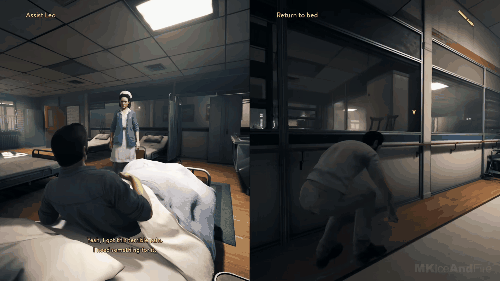
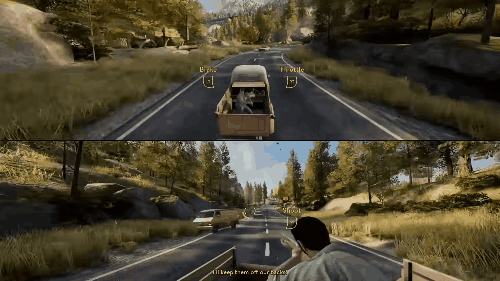

What’s already unique in A Way Out is that all these elements are developed with the co-op aspect in mind: without one player, the other (and the whole game) cannot move forward.
Or, like in one of our favorite sections, both players have to execute a skill check in order to get up into a vent. The nice touch here is that if one player goes too far forward, then both players risk failing, incentivizing the idea that players should wait for each other and try to keep the same pace.

As we said at the beginning, the story of A Way Out is the actual focus of the experience. Although there are some clichés, the story is indeed very entertaining, including a nice ending focused on the co-op experience of the game (we won’t make any spoilers). But in the end, it’s the co-op spirit of the game that makes it unique. From the very beginning up to the end, the two players share most of the situations and discuss how to proceed in the game — this is what makes A Way Out special. The game is far from perfect, but it was a small hit, and it showed Fares that they had found an interesting, unexplored space in the industry.
So Hazelight kept the idea and improved it.
One of the big changes from A Way Out to It Takes Two is that with the latter, the gameplay experience takes over the story.
A Way Out was built with the idea of “How do I tell an interesting story for two players to experience together?”, while we think that It Takes Two responds more to the question, “How do I let two players have fun, explore a new world, and overcome challenges together?”
This switch is probably one of the main reasons why Hazelight became one of the most beloved studios so quickly in recent years; Fares detached almost completely from his movie past and embraced the core of gaming, with the co-op gameplay becoming the center of everything.
It Takes Two
Almost everyone knows and has played It Takes Two, the winner of the Game of the Year Award in 2021.

It Takes Two is an action-adventure co-op platformer where you play as Cody and May, two parents who are turned into dolls by a magic spell. Together, you have to confront different challenges, where you get to learn more about each character and, at the same time, experience different gameplay elements.
The core is no longer the story, but Hazelight succeeded in making every centimeter of It Takes Two fun when played together with someone else.
But making a game that is focused on co-op platform mechanics and making it varied enough to engage players for ~10 hours is very different from making a story-driven game with limited gameplay. To succeed in this, we think that the biggest change the team made was related to the team’s structure. We can get an idea about this shift from an interview done by some of the team’s designers:
“Generally, when we work, we work in small teams, pods, consisting of two designers, two programmers, two artists, and two animators. [...] Together, the pod owns a few levels, with fairly little outside help.”
If you have played It Takes Two, you can easily tell how a pod structure is a good fit for this kind of game. In It Takes Two, each chapter/world has its own game mechanics, its own style, and its own intent. By setting up pods with a lot of autonomy, you almost automatically get a lot of variety and a lot of ideas, which is exactly what every player appreciates about It Takes Two.
Given this freedom, you have some pods more focused on combat (shooting something with a gun or using a sword to kill enemies), while others are more focused on platforming (changing gravity or changing the size of the player). They are not mutually exclusive, which means that in one level you can have a mechanic that is used both in combat and for platforming. To give a better overview of all the mechanics present in the game and what the teams came up with, we grouped them into four main categories:
Environmental = the mechanic is used to change the environment (smash objects, spawn platforms, etc.)
Platformer = the mechanic is used to perform platforming actions (swing, grapple, etc.)
Combat = combat/shooter mechanics
Puzzle = the mechanic is used to solve logic puzzles
Let’s see one example for each of them:
Environmental: Sap Cannon
Cody can use this weapon to fire sap onto the surrounding environment. By doing so, he can “modify” the environment to continue in the level. For example, in this GIF, the player has to use it to lower a platform and allow both players to jump on it

Platformer: Fidget spinner
Both players are given the same ability here. They get a fidget spinner that allows them to traverse big gaps by flying on it

Combat: Knight Costume and Wizard Robes
Here we have a completely different approach. Each player has abilities that resemble those of an RPG game: the knight can swing a fire sword, and the wizard can launch freezing spells

Puzzle: Cloning and teleporting
Here May can use this ability to clone herself and teleport to it, making it possible to reach otherwise unreachable areas. As you can see here, there’s no platforming involved, no modification of the world, and no combat. Solving the puzzles depends entirely on logic

Below is the summary of how the various mechanics were distributed in the game.


This switch from story to gameplay, combined with a new team structure that gave a lot of freedom to each pod to innovate and create unique experiences within the game, elevated It Takes Two well above A Way Out and allowed the game to win the GOTY.
With such high expectations, Hazelight worked on the next title, Split Fiction, which was released four years later. Let’s see what we think about it.
Split Fiction
While, as we saw, there is a big shift between A Way Out and It Takes Two in terms of game and team structure, Hazelight chose not to overdo it with Split Fiction and instead tried to build a bigger and better It Takes Two: more polish, improved graphics, but as a result, we think it also lacks some of the charm of the previous title.
The protagonists are Mio and Zoe, two writers struggling to find a publisher for their books. This is where the antagonist comes in: Rader is the CEO of Rader Publishing, who promises a good offer to Mio, Zoe, and other authors if they enter a simulation designed to help them reach their full potential.
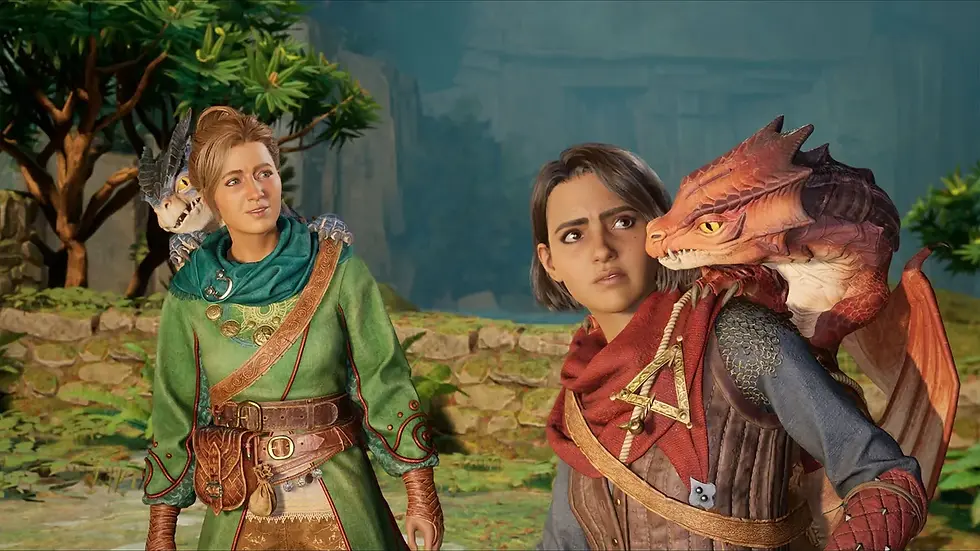
Just like It Takes Two, Split Fiction is divided into different worlds, each with its own mechanics and unique points. The gimmick here is that Mio is a sci-fi writer while Zoe is a fantasy writer. In the game, players enter worlds based on the stories that each character wrote, making it easy to have different visual environments and unique gameplay mechanics.
Let’s analyze Split Fiction in the same way we analyzed It Takes Two.


As you can see from these graphs, while It Takes Two had more variety and leaned heavily on Environmental and Combat mechanics, Split Fiction pushes further into Platformer and Puzzle elements.
This shift seems deliberate: Split Fiction is designed for players who enjoy challenge and precision. While it may be less immediately accessible to casual players, it rewards skill, coordination, and problem-solving. By contrast, It Takes Two embraced more moments of controlled chaos, goofiness, and playful experimentation, which made it approachable to a broader audience. Split Fiction trades some of that charm for tighter, more intricate gameplay. We think this is a conscious design decision to make it more appealing to core gamers.
The story reflects the same distinction. The world of It Takes Two is magical, light-hearted, and whimsical, whereas Split Fiction is more serious, with a clear antagonist and a narrative structure closer to an action movie. Hazelight is showing here that they can evolve the experience, prioritizing gameplay depth without losing their signature co-op design philosophy.
In conclusion, there isn’t much new to say about Split Fiction that hasn’t been said before, but it is clearly a bolder version of It Takes Two. It received higher reviews than It Takes Two (91 vs. 88 on Metacritic), and while it didn’t win GOTY (we also think because it didn’t have the same “wow” impact of its predecessor), it proves that Hazelight is capable of refining and deepening their co-op formula. The game may not dominate casual discussion as It Takes Two did, but it is a triumph for core players. Sales are already strong (Split Fiction has surpassed 4M), and we expect its influence on co-op design to grow.
The friends pass
Apart from the design aspects of the games, we think that another winning strategy from Hazelight came from the friend-pass approach. Since A Way Out, if two players want to play the game together, they only need one copy of the game.
At a time when companies were thinking about new monetization strategies, Fares again went against the current and delivered a masterpiece in understading players's needs.
This is how Josef Fares announced the friend pass on X:
This was another move that made Hazelight stand out when comparing it to other developers, strengthening their concept of couch co-op game and of playing games together.
Conclusions
In a market that is full of games based on market analysis, player data, and trends, Hazelight and Josef Fares represent the exact opposite, showing that even without all of that, it is possible to deliver something meaningful and unique to players.
Since the early days, Fares has focused on delivering a specific experience, neither incredibly unique nor technologically advanced. But all of his games are fun, and in the end, that’s probably what players are looking for. He started small and reiterated and expanded his vision over the course of three games, with the last, Split Fiction, standing as the magnum opus of what he wanted to achieve.
If, as Fumito Ueda suggests, the “era of game mechanics” may be over, Hazelight shows that maybe the era of clarity of vision is just beginning. Fares’ career proves that a strong, consistent vision can guide a studio to create experiences that are memorable, emotional, and genuinely enjoyable.
We think the studio will try something new going forward, and we are excited to see what they might be cooking. For now, let’s appreciate one of the most successful stories of the 2000s, achieved and pursued without the noise and clamor of other people and studios who might have achieved not even half of the same success.
If you have not played his games yet, please do!
Bonus - LinkedIn Posts about development
While writing this article, we stumbled upon some LinkedIn posts that showcase part of the making of It Takes Two and Split Fiction. These were made by Per Stenbeck, who’s now the Lead Designer at Hazelight.
We thought it would be an interesting sneak peek for those reading this article, so here it is!


Comments